Key Takeaways
- When a recruiter asks you to rewrite your CV, it usually means the client's essential criteria are not evidenced - not that it is badly written.
- Agencies have a legal duty to confirm your experience and qualifications - and can only confirm what the CV states.
- Agree to changes that make true things visible. Refuse any that make untrue things look true.
You send your CV to a recruitment agency, the consultant comes back with a list of changes, and it lands badly. You wrote that CV. It got you your last two jobs. Now someone who has known you for nine minutes wants the dates reformatted, the profile rewritten and the whole thing sent again in Word.
The request is almost never a verdict on your writing. When a recruiter asks you to rewrite your CV, they are usually looking at a gap between what the client asked for and what your document lets them prove - and unlike you, they have read the client's requirements and know what the submission has to survive.
What happens to your CV after you send it to a recruiter
The consultant is not the audience. They are the first of four stages, and each one strips away a little more of whatever your CV implies rather than states.
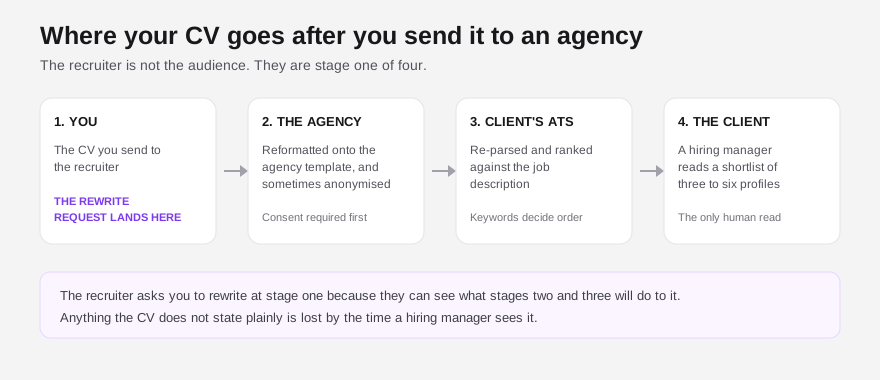
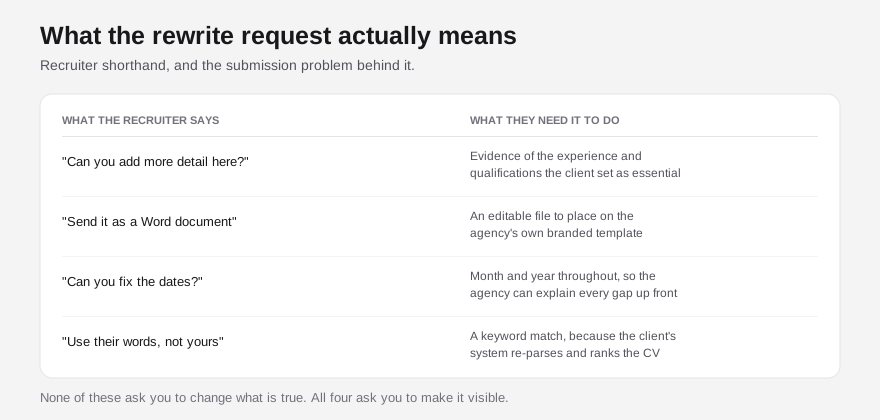
Two things in that chain surprise most candidates. The first is that agencies routinely rebuild your CV onto their own branded template before it reaches the client - which is why "can you send it as a Word document" is such a common request. A PDF has to be retyped; an editable file can be transferred in minutes. Some clients, particularly in the public sector and financial services, also require submissions to be anonymised before shortlisting.
The second is that the client's own Applicant Tracking System usually parses the CV again at the far end. The agency's formatting does not exempt you from that. Our breakdown of what an ATS actually does with your CV covers the extraction and ranking stages your document still has to clear.
The legal reason a UK agency cannot just send your CV as it is
This is the part almost no candidate knows, and it explains most rewrite requests on its own.
Under the Conduct of Employment Agencies and Employment Businesses Regulations 2003, an agency may not introduce or supply a work-seeker to a hirer unless it has obtained confirmation of that person's identity and that they have "the experience, training, qualifications and any authorisation which the hirer considers are necessary" for the role. Regulation 21 then requires the agency to pass that information to the hirer when it proposes you, and if it does so verbally, to confirm it in writing no later than the end of the third business day.
So the consultant is not being fussy about your bullet points. They have a statutory duty to tell the client, on the record, that you hold the experience and qualifications the client specified. If your CV says "responsible for financial reporting" and the client set "part-qualified ACCA or CIMA" as essential, there is nothing on the page for the agency to confirm. The rewrite request is them asking you to put it there.
The same logic applies to certifications, right-to-work-adjacent authorisations, SIA licences, driving entitlements and registration with a professional body. If the role requires it and your CV does not state it plainly, expect to be asked.
Key point: The agency is not allowed to assume. Anything the client called essential has to appear on the document in a form the consultant can point at.
The five reasons recruiters ask you to rewrite your CV
Beyond the compliance duty, the same handful of problems come up again and again.
- The essential criteria are not evidenced. The most common one. You have the experience, but it is buried in a duty-only bullet or implied by a job title rather than stated.
- The file cannot be edited. A PDF blocks the agency's reformatting step, and a scanned or image-based CV blocks it entirely.
- The dates are vague. Years without months hide the length of a gap. Agencies get pushed on this by clients, so they push on it with you first.
- The vocabulary does not match the advert. The client's system ranks on the client's terms. If the role says "stakeholder management" and you wrote "worked with the wider business", you lose the match.
- The CV is aimed at a different job. A generic CV forces the consultant to argue your case in a covering email the ATS never scores.

What you should agree to change - and what you should not
There is a clean line here, and it is worth holding.
Say yes to anything that makes something true easier to see. Rewriting a duty as an achievement, adding the qualification you actually hold, converting "2019–2022" to "March 2019 – August 2022", reordering sections so the relevant experience sits on page one, adopting the client's terminology for work you genuinely did - all of that is presentation, and all of it is your call to make.
Say no to anything that changes the facts. Inflating a job title, extending an end date to close a gap, adding a system you have never used, or claiming a qualification you are still studying for are not formatting decisions. A small number of consultants do ask, usually framed as "the client won't mind" or "everyone does it". They will not be in the room when the reference check comes back. Our guide on rewriting your CV without lying covers the grey areas - job titles, the "we" problem, estimated figures - in more detail.
Two practical points on the middle ground:
- Ask to see the edited version before it goes out. Reputable agencies will send it. The REC Code of Professional Practice requires members to have consent or another documented legal basis before submitting your personal information to a client, so you are entitled to know what is being sent in your name.
- Keep your own master copy. The agency version is built for one client. You still need a document you control, which is the master CV plus per-application tailoring approach.
How to rewrite your CV so recruiters stop asking
Most of these requests are avoidable. Before you send your CV to any agency, work through the advert once.
- List the essential criteria from the job description. Not the desirable ones. The essentials are what the agency is legally obliged to confirm.
- Find where each one is evidenced on your CV. If you cannot point at a line, it is not there - and the consultant will not be able to either.
- Use the advert's vocabulary for anything you genuinely have. Not padding, matching. Our guide to finding and using ATS keywords covers where in the document each term should sit.
- Put month and year on every role. Including the gaps. A stated gap is a fact; an unexplained one is a question.
- Send it as a .docx. Keep a PDF for direct applications, but give the agency something it can work with.
- Name your qualifications explicitly. "AAT Level 4 (completed 2023)" beats "fully qualified" every time, for a human and a parser.
Do those six things and the consultant's reply is usually "great, I'll put you forward today".
FAQ
Is it normal for a recruitment agency to change my CV?
Yes. Most UK agencies rebuild candidate CVs onto their own branded template before sending them to a client, and some anonymise them where the client requires blind shortlisting. What is not normal is changing the substance - dates, titles, qualifications - without your agreement. Ask to see the version being submitted.
Can a recruiter send my CV to a client without asking me?
They should not. The REC Code of Professional Practice requires members to obtain consent, or have another documented legal basis, before disclosing or submitting your personal information. If an agency has sent your CV somewhere without telling you, ask them in writing which clients hold it.
Does the recruiter asking me to rewrite my CV mean it is bad?
Usually not. It more often means the CV was written for a different audience than the specific role they have in mind, or that something the client called essential is implied rather than stated. A CV that worked well for direct applications can still need a pass before an agency submission.
Should I use the recruiter's CV template?
If it is their internal branded template, they will handle it - you just need to supply an editable file. If a consultant sends you a blank template to fill in, it is usually because their client wants submissions in a consistent format. It is reasonable to use it, and reasonable to keep your own version for applications you make directly.
Why do recruiters want my CV in Word rather than PDF?
Because they reformat it. Extracting text from a PDF is slower and often loses the structure, while a .docx transfers into the agency template quickly. It is a workflow request, not a comment on your file choice - most client ATS platforms accept both.
Find the gap before the recruiter does
Nearly every rewrite request comes down to the same thing: something the client asked for is true about you but not visible on the page. That is difficult to spot in your own CV, because you know what you meant.
Scan your CV free - Shadow CV reads it the way an employer's system does and shows you which requirements are actually evidenced, which keywords are missing, and what disappears in the parse. The £5 rewrite fixes what the scan finds and rebuilds the CV around the evidence a recruiter needs to put you forward - once, with no monthly subscription.