Key Takeaways
No mainstream UK ATS checks whether AI wrote your CV, and the detection tools that claim to are wrong more than half the time. The real risk of an AI-written CV isn't getting caught - it's sounding identical to thousands of other UK applications. Keep your real numbers, tools and achievements to stand out.
If you used ChatGPT, Gemini, or Claude to help write your CV, you've probably had the same anxious thought: will a UK recruiter be able to tell? (The reverse question - what happens when the employer's software is the thing making the decision - has a firmer answer, because the regulator has now looked at it.) The honest answer is reassuring in one way and uncomfortable in another. No mainstream applicant tracking system (ATS) checks whether AI wrote your CV, and the standalone detectors that claim to are unreliable enough that no serious recruiter should trust them. But using AI to write a CV carries a different, quieter risk - one that has nothing to do with getting caught.
Can recruiters tell if you used AI to write your CV?
Two different systems sit between you and a human recruiter, and neither is looking for AI.
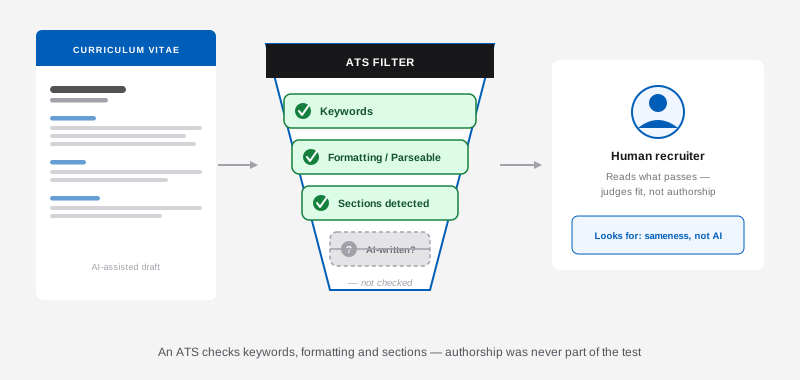
The first is the ATS. It parses your CV into structured fields - name, contact details, work history, skills - matches the text against the keywords in the job description, and scores how cleanly it could read your formatting. It does not have an "AI or human?" setting. A well-structured, keyword-matched CV passes the same whether you wrote every word yourself or drafted it with a chatbot. If you want the detail on what actually happens at this stage, we've covered it in what an ATS does with your CV.
The second is the small industry of AI-detection tools. They exist, but they are not something a careful recruiter relies on. A widely cited study published in Patterns tested seven popular detectors and found they wrongly flagged non-native English essays as AI-written around 61% of the time - a false-positive rate high enough to make the tools useless for any decision that matters. Later academic reviews reached the same verdict: current detectors are ineffective, inconsistent, and biased against people who don't write in a standard native-English register. Reputable guidance now warns against using them at all.
So the technology can't reliably catch you, and the ATS was never trying to. What a human recruiter can spot is something else entirely.
How common is using AI to write a CV in the UK?
Common enough that it is now the norm, not the exception. Prospects Luminate's Early Careers Survey 2025 found that among UK applicants:
- 39% used AI to edit a CV or cover letter
- 30% used it to write one from scratch
- 29% used it to prepare for or practise interviews
A more recent Luminate wave put the combined figure higher still: nearly three quarters of respondents said they had used AI at some point in the application process, and 46% had used it to write a CV or cover letter. The Institute of Student Employers, meanwhile, reported application volumes per vacancy rising sharply - up 26% in a single season and accelerating - largely because AI makes it so easy to fire off a decent-looking application in minutes. Much of that AI use covers cover letters as well - though whether your cover letter even needs to pass ATS is a separate question from the CV.
The takeaway: you are not doing something unusual or shameful. You are doing what almost everyone else is doing. Which is exactly the problem.
What an ATS actually checks (and why it isn't authorship)
An ATS scores three things, none of which is who wrote the CV:
- Keywords - does your CV contain the terms from the job description, in the wording the employer used? Mirroring those exact phrases is the single highest-leverage thing you can do, and it's covered in how to find and use ATS keywords.
- Parseability - can the software read your layout? Single-column, standard headings, contact details in the body not the header, no tables or text boxes.
- Structure - are the expected sections present and correctly labelled?
That's the whole gate. An AI-assisted CV that is well-structured and keyword-matched sails through, because the ATS is testing whether a machine can read you and whether you match the role - not whether a machine helped you write it. The filter that AI-written CVs actually struggle with is the human one on the other side.
The real risk of an AI-written CV: sameness
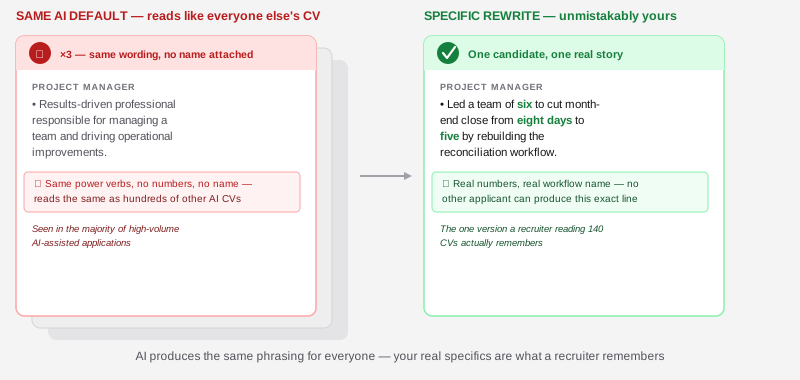
Here is what happens when thousands of applicants prompt the same handful of tools with roughly the same instructions. The outputs converge. The same power verbs appear ("spearheaded", "results-driven", "leveraged"). Numbers get rounded a little too cleanly. Professional summaries start to read like they'd fit anyone. When an outsourcing firm asked applicants to record a short video answering one question in early 2026, it received more than 300 responses that were, in the reporting, eerily alike - similar enough that it was obvious AI had written them.
Prospects' own careers guidance makes the point plainly: AI tools can't capture your voice or the specific detail of your experience, which can leave an application sounding "generic or robotic." And the data suggests the people leaning hardest on AI are exactly the ones most at risk of blending in - among applicants submitting 101–200 applications, 66% used AI, compared with 40% of those sending 20 or fewer. High volume and heavy AI use travel together, and the result is a stack of interchangeable CVs.
A recruiter working through 140 applications for a single graduate role isn't running them through a detector. They're scanning for the one CV that isn't like the other 139. If yours reads like the machine average of every CV for that role, being "undetected" won't save you - you'll be filtered out for being forgettable, not for being caught.
How to use AI on your CV without sounding like everyone else
AI is genuinely useful for CVs. The trick is to use it for the chores and keep the thinking yours.
- Keep your real specifics. Exact figures, named tools, real employers, actual outcomes - these are what make you distinguishable, and they're the one thing AI can't generate because it doesn't know them. Never let it round "cut processing time from 8 days to 5" into "improved efficiency". Our guide to CV bullet points that pass ATS covers the specific-and-measurable formula.
- Use it to mirror the job's keywords. This is where AI earns its place - feed it the job description and ask which exact terms your CV is missing, then integrate the ones your experience genuinely supports.
- Cut the filler. Delete "results-driven professional", "passionate about", and any summary that could belong to a thousand other people.
- Keep your voice. Read the final version aloud. If it doesn't sound like you, rewrite it until it does.
- Never let it fabricate. Invented skills, inflated titles, or made-up numbers are both a sameness tell and a genuine liability - they unravel at interview and reference stage.
Compare two versions of the same line. The generic AI default: "Results-driven professional responsible for managing a team and driving operational improvements." The specific version: "Led a team of six to cut month-end close from eight days to five by rebuilding the reconciliation workflow." Same person, same job - but only one of them is unmistakably yours, and only one gives a recruiter something concrete to remember.
Should you tell UK employers you used AI?
Employers are divided, so there's no single rule. Oxford University's Careers Service asked recruiters in May 2025 whether they allow or encourage AI in applications: only 15% said yes, while around half said no outright. Candidates are ambivalent too - in the Luminate survey, only 38% thought it was acceptable for employers to use AI to screen CVs, even as most used AI to write them.
The practical line is honesty, not disclosure for its own sake. Check whether the employer states a policy; a growing number now explicitly permit or even encourage AI as a drafting aid. Where nothing is stated, using AI to structure, tighten, and keyword-match your own real experience is widely considered fair. Using it to invent experience you don't have is not - and that's the line that actually matters, far more than whether a tool touched the document.
FAQ
Does an ATS reject CVs for being AI-generated?
No. An ATS scores keyword match, parseability, and structure. It does not assess whether a human or an AI wrote the text, so authorship plays no part in whether you pass the automated stage.
Can recruiters detect an AI-written CV?
Not reliably. Dedicated AI detectors are error-prone - one study found a false-positive rate above 60% for non-native English writers - and most recruiters don't use them. What recruiters do notice is generic, interchangeable writing that reads like every other AI CV.
Is it cheating to use AI to write my CV?
It depends on the employer and how you use it. Polishing, structuring, and keyword-matching your genuine experience is broadly accepted in the UK. Fabricating skills or achievements is not, and it tends to surface later at interview or reference stage.
Will using ChatGPT hurt my chances?
Only if you submit the generic, un-personalised output. Keep your real numbers, tools, and achievements, cut the filler, and make sure it sounds like you rather than the machine average.
Should I use an "AI humaniser" tool to disguise it?
No. These tools are built to beat detectors that almost no recruiter uses, and they tend to make your writing worse. Your effort is far better spent adding the specific detail only you can provide.
Scan your CV free - Shadow CV shows you exactly what an ATS filter is missing. The £5 rewrite integrates the keywords it needs and fixes the formatting that breaks parsing, without stripping out what makes it yours - your real numbers, tools, and achievements stay, once, no subscription.