Key Takeaways
In the UK, cover letter ATS screening is mostly a myth - it's your CV that gets filtered automatically. A cover letter matters more at the human stage: for smaller employers, writing-focused roles, when explicitly requested, or when explaining a career change or gap. Get your CV right first.
There is more conflicting advice about cover letters and ATS than almost any other job-search topic. One site insists 94% of hiring managers read every cover letter. Another reports that half of recruiters never open them. Both cite real surveys. So what is actually true, and does your cover letter need to be "ATS-optimised" the way your CV does?
Here is the honest version, focused on the UK. In most cases, the Applicant Tracking System is filtering on your CV, not your cover letter. The cover letter rarely decides whether you clear the automated gate. Where it earns its place is later, at the human stage - and only under specific conditions. This guide explains how cover letters and ATS actually interact in UK hiring, when a cover letter genuinely moves the needle, and how to write one that helps rather than wastes your time.
If you are not yet clear on how the underlying screening works, start with what ATS software is and why it rejects CVs.
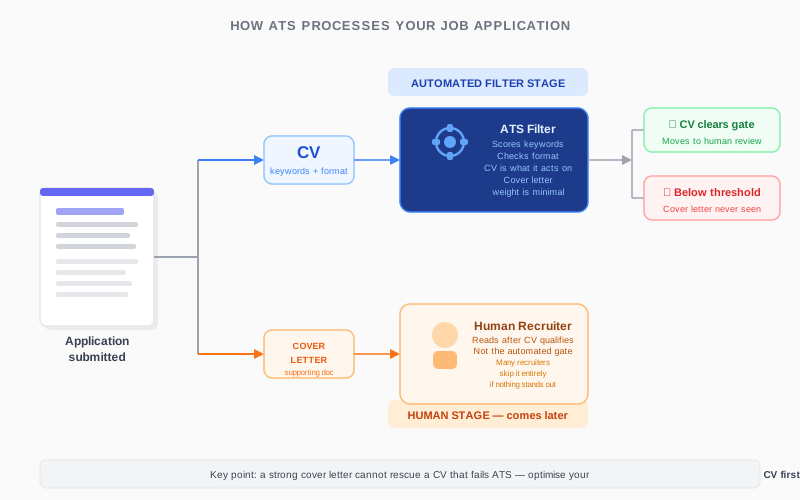
Does ATS Actually Scan Your Cover Letter?
Sometimes - but it rarely matters. Most enterprise ATS platforms can store and parse a cover letter, but the score that ranks you against other candidates is built overwhelmingly from your CV: the keywords, the job titles, the dates, the skills. The cover letter carries far less weight in that calculation, and at many large employers it is not even opened until your CV has already cleared the automated threshold.
The practical takeaway is blunt: a brilliant cover letter cannot rescue a CV that fails ATS keyword matching. If your CV scores below the recruiter's review line, the cover letter is never read. This is why your effort is better spent getting the CV right first. In the UK, where around 98% of large organisations use automated screening and roughly three in four CVs are filtered out before a human sees them, the CV is the gate - and the gate is where you win or lose.
What the UK Data Actually Says About Cover Letters
The headline statistics people quote are mostly American, which is part of why they conflict. The UK picture is more measured:
- In a CV Genius UK survey, 49% of hiring managers said they expect candidates to submit a cover letter, and 56% believed candidates who include one are more passionate about the role.
- The same research found 71% of UK hiring managers rely on an ATS when recruiting - confirming that automated screening, focused on the CV, is the norm.
- A 2025 UK LinkedIn survey by recruitment firm Salt found roughly 30% of hiring managers rarely read cover letters, and that both candidates and hiring managers rate the CV as more important than the cover letter.
Read together, these tell a consistent story. A cover letter is expected often enough that omitting one can count against you, but it is not the document the machine filters on, and a sizeable minority of humans will not read it closely. It is a supporting act, not the headliner.
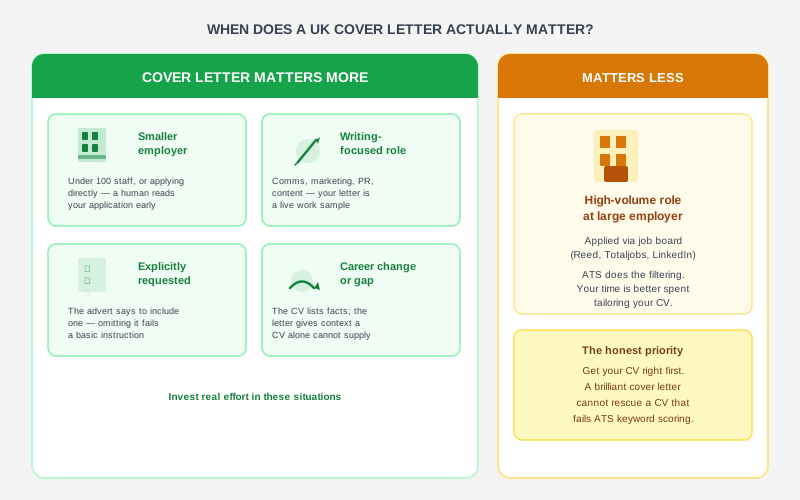
When a Cover Letter Genuinely Matters in the UK
A cover letter shifts from optional to important in a few specific situations. These are the times to invest real effort:
-
Smaller employers and direct applications. At companies with under 100 staff, or when you apply directly rather than through a large ATS portal, a human is more likely to read your application early - and the cover letter with it.
-
Writing-focused roles. For communications, marketing, PR, content, and similar positions, your cover letter is a work sample. A weak one is actively damaging.
-
When the posting explicitly asks for one. If the advert says "include a cover letter explaining your interest" and you do not, you have failed a basic instruction - and some application forms flag missing required fields.
-
Career changes and employment gaps. The cover letter is where you give context a CV cannot: why you are switching fields, or what a gap represents. The CV lists facts; the letter supplies the story.
-
UK public sector applications. NHS and school posts are the clearest case of all: they usually replace the cover letter with a scored supporting statement inside the application form, and it is often the only free text you write. Both are worth real effort - see our NHS nurse supporting statement guide and teacher letter of application guide for how each is assessed.
If none of these apply - a high-volume role at a large employer, applied through a major job board - your cover letter is unlikely to be the deciding factor, and your time is better spent tailoring your CV.
How to Write a Cover Letter That Helps (Not One That Hurts)
When a cover letter will be read, a generic one is worse than none. UK recruiters spot template language instantly, and a low-effort letter reads as low interest. The rules are simple:
- Keep it to 250–400 words, three or four short paragraphs. Recruiters give it under two minutes.
- Name the role and the company in the opening line. Generic openings like "To Whom It May Concern" cause immediate disengagement.
- Mirror the language of the job advert. Pull three or four key requirements and reflect them naturally - this helps both a human reader and any parsing the ATS does, without keyword stuffing.
- Lead with one concrete, quantified achievement rather than restating your CV. "Recovered 65% of lost revenue within six weeks" beats "I am a strong problem-solver."
- Do not repeat your CV. Add context, motivation, and one story that proves your value.
Keep the formatting ATS-safe for the same reasons your CV must be: standard fonts, no tables, no images, plain paragraphs. If the cover letter does get parsed, you do not want it mangled. For the keyword discipline that applies here too, see how to find and use ATS keywords in your CV, and for turning duties into quantified lines, how to write CV bullet points that pass ATS.
The AI Cover Letter Trap
Around one in five candidates now use AI to write cover letters, and UK recruiters have noticed. The risk is not that you used a tool - it is that a mass-produced, generic letter reads as exactly that, and recruiters increasingly screen for it. A letter that names no specific company initiative, cites no concrete achievement, and could be pasted onto any application is a negative signal. If you use AI to draft, the work is in making it specific afterwards: real numbers, the actual company, your genuine motivation.
The same trade-off applies to your CV, where the choice is usually between paying a writer and doing it yourself with AI assistance. CV writer versus AI sets out what each actually solves.
FAQ
Does an ATS read my cover letter or just my CV?
Most ATS platforms can parse a cover letter, but they score and rank you primarily on your CV. At many large UK employers the cover letter is not even opened until your CV has cleared automated screening. Optimise your CV first - it is what the filter acts on.
Should I always include a cover letter in the UK?
Roughly half of UK hiring managers expect one, so including a tailored cover letter is generally safer than omitting it - especially for smaller employers, writing-focused roles, or when the advert requests it. For high-volume roles at large employers applied through a job board, it matters less.
Can a great cover letter make up for a weak CV?
No. If your CV fails ATS keyword matching and scores below the review threshold, your cover letter will not be read. A cover letter influences the human decision after your CV qualifies you - it cannot rescue one that does not.
How long should a UK cover letter be?
Three or four short paragraphs, 250–400 words. UK recruiters spend under two minutes on it. Anything longer risks being skipped entirely.
Will an AI-written cover letter get me rejected?
It can, if it reads as generic. UK recruiters increasingly screen for mass-produced AI letters. Using AI to draft is fine - but you must make it specific to the role and company, with real achievements, before sending.
Get Your CV Past the Filter First
The honest priority order is simple: your CV is what the ATS filters on, so that is where your effort should go first. A tailored cover letter helps at the human stage - but only once your CV has cleared the gate.
Scan your CV free - Shadow CV checks it against ATS requirements and shows you exactly where it's losing points. The £5 rewrite makes it formatted correctly, keyword-rich, and ready to pass automated screening - once, with no monthly subscription.