Key Takeaways
- The CV red flags UK recruiters notice most are spelling errors, unexplained gaps, generic untailored content, duties without achievements, and formatting that breaks in an ATS.
- Most are fixable in an afternoon - the recruiter is reacting to sloppiness or vagueness, not judging your actual ability.
- Fix the flags before you apply, not after the rejections arrive.
A recruiter skimming a stack of applications is not reading your CV - they are scanning it for reasons to say no. Popular vacancies attract far more applications than a recruiter can read in full, so cutting the pile down fast is the job. A CV red flag is anything that gives them a quick, defensible reason to move you to the "no" pile without reading further.
The good news: most red flags are not about your experience or your ability. They are about presentation, and presentation is the one thing entirely within your control. Here are the red flags that do the most damage in the UK job market - and exactly how to clear each one.
What counts as a CV red flag to a UK recruiter
A red flag is not the same as a weakness. A career gap, a short stint, or a non-linear path are facts about your history. They only become red flags when they are left unexplained, badly presented, or buried in a CV that already looks careless. A run of eight-month roles is a good example: a bracketed clause naming the contract type turns the same dates from a worry into a description of the sector.
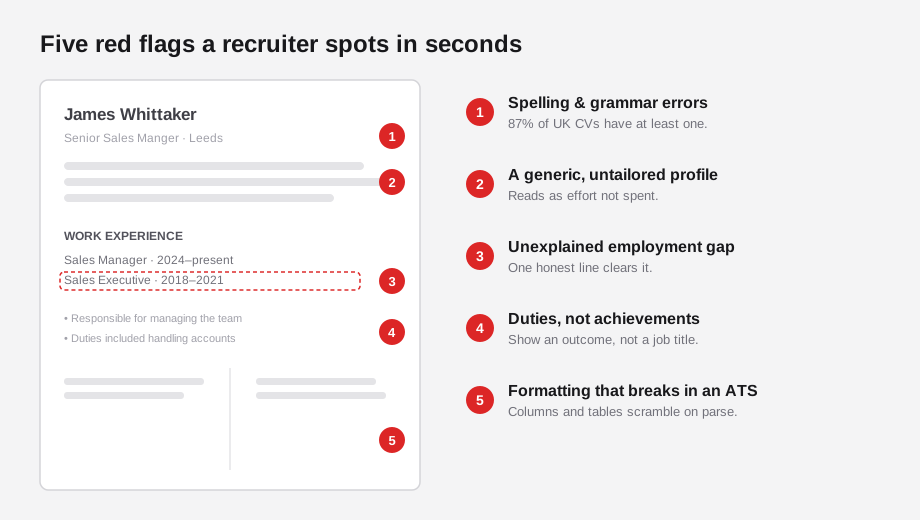
The pattern to understand is compounding. One typo on an otherwise sharp CV might be forgiven. But the recruiter is building an impression with every line, and red flags reinforce each other. A generic profile plus vague bullet points plus a formatting error reads as one thing: not much effort went into this. That is the judgement you are trying to avoid.
The most common CV red flag: spelling and grammar
This is the red flag recruiters mention first, and the data explains why they are so alert to it. When Adzuna analysed over 267,000 UK CVs uploaded to its ValueMyCV tool in 2023, 87% contained at least one spelling or grammar mistake. Only 13% were error-free. More than a third had five or more errors.
That prevalence cuts both ways. It means a genuinely clean CV stands out - but it also means recruiters treat errors as the default and screen for them ruthlessly. A misspelled job title or a "manger" where you meant "manager" reads as a lack of care about the very document meant to represent your best professional self.
To clear it:
- Read the CV aloud, slowly. Your ear catches errors your eye skims past.
- Check the words spellcheck won't flag: "form" versus "from", "manger" versus "manager", "lead" versus "led".
- Confirm every company name, job title, and qualification is spelled exactly right - these are the errors recruiters find least forgivable.
- Have one other person read it. A fresh pair of eyes finds what you have stopped seeing.
Employment gaps: the red flag that's losing its power
An unexplained gap on a CV used to be a reliable trigger for suspicion. That is changing, because gaps are now normal. LiveCareer UK analysed nearly 19 million CVs created between 2020 and mid-2025 and found the share of job seekers with no employment gap at all fell from 61% to 51%. Gaps of six months or more rose from 24% to 32% of CVs over the same period. As their report put it, career gaps are now the norm, not the exception.
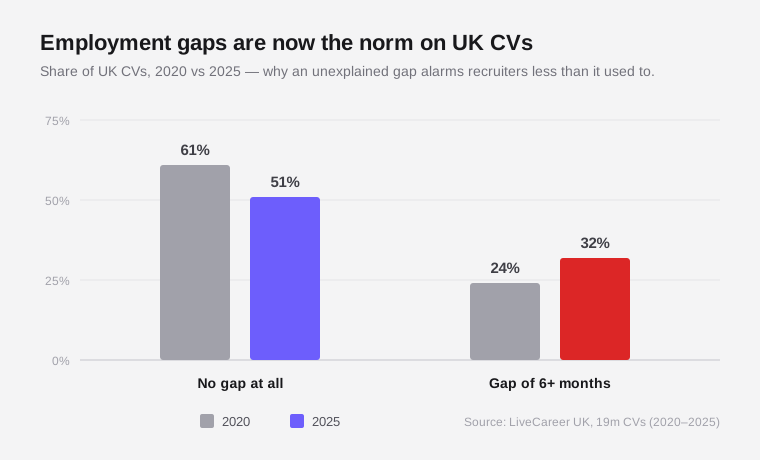
The red flag, then, is not the gap itself - it is leaving it silent and hoping nobody notices. A recruiter who spots an unexplained 14-month hole will fill it with the worst assumption. A one-line explanation removes the doubt entirely.
- State the gap plainly and briefly: "Career break - full-time caregiving (2023–2024)" or "Redundancy, followed by a retraining course in data analysis".
- Include anything you did that keeps you current: freelance work, volunteering, a course, a certification.
- Use years rather than months for older roles, which naturally smooths over short gaps without hiding anything.
You are not obliged to over-explain. One honest line does the work - our full guide to explaining employment gaps on your CV covers the wording, the career-break entry pattern, and the popular fixes that backfire. If your applications are consistently going unanswered, gaps are rarely the real cause - our guide to why your CV isn't getting responses covers the more common culprits.
The generic CV: a red flag hiding in plain sight
A CV that could have been sent for any job tells a recruiter you did not think hard about this one. Generic personal profiles are the clearest tell - a "hard-working team player seeking a challenging role in a dynamic company" says nothing and appears on thousands of CVs. Recruiters have read it so many times it registers as noise. Replacing the adjectives with your role, your scope and one number is the whole of the fix: what to put in those four lines instead takes about ten minutes.
The fix is tailoring, and it does not mean rewriting from scratch. It means making the top third of your CV - the profile and your most recent role - obviously relevant to the specific advert. Mirror the language of the job description where it honestly applies to you. The evidence that this pays off is strong: our breakdown of whether to tailor your CV for every job covers the numbers, but the short version is that a tailored CV converts to interviews at roughly twice the rate of a generic one.
Duties instead of achievements
A CV that lists what you were responsible for, rather than what you actually accomplished, is a quiet red flag. "Responsible for managing the team's budget" tells a recruiter your job title. "Managed a £400k budget and cut overspend by 12% in a year" tells them what you can do. The first is a description; the second is evidence.
Recruiters read duty-only CVs as a signal that the candidate either did not achieve much or cannot articulate what they achieved. Neither impression helps you. Every bullet point is a chance to prove a claim, and wasting it on a job description is a missed opportunity a competitor will not miss.
- Lead each bullet with a strong action verb: delivered, reduced, launched, negotiated, built.
- Attach a number wherever you honestly can - money, time, percentage, headcount, volume.
- Cut bullets that only restate the job title. If it is obvious from your role, it is not earning its place.
Our full method for this is in the guide to writing CV bullet points that pass ATS - the same action-plus-outcome structure works for both the software and the human reading behind it.
Formatting red flags that stop your CV being read
Some red flags never reach a human at all. Multi-column layouts, text boxes, tables, and contact details tucked into the document header routinely break when an Applicant Tracking System parses your CV into plain text. ATS software is standard at large employers, so a CV that parses into garbled text does not get flagged as a problem - it simply never surfaces when the recruiter searches the database.
This is the most dangerous category of red flag precisely because it is invisible to you. You submit a CV that looks beautiful in Word, and it arrives at the other end as scrambled fragments. The recruiter never sees the design; the software saw a mess. Our technical breakdown of how ATS parses your CV walks through exactly where this goes wrong.
Keep the machine-readable version clean:
- Single-column layout, standard headings (Work Experience, Education, Skills).
- Contact details in the body of the document, never in the header or footer.
- No tables, text boxes, or graphics carrying important information.
- A common, safe font and a standard .docx or PDF export.
A quick red-flag audit before you apply
Run this pass over any CV before you send it. Each item maps to a red flag above and takes minutes to check.
- Spelling - read it aloud; check names, titles, and qualifications letter by letter.
- Gaps - every gap over three months has a one-line explanation.
- Relevance - the profile and top role obviously match this specific advert.
- Evidence - most bullets show an outcome, not just a duty.
- Formatting - single column, no tables, contact details in the body.
Five checks. Clearing all five puts you ahead of the majority of the pile - remember, only 13% of CVs are even free of spelling errors before we get to the rest.
FAQ
What is the biggest red flag on a CV?
Spelling and grammar mistakes are the red flag recruiters cite most often and screen for hardest, because they read as carelessness about your most important professional document. With 87% of UK CVs containing at least one error, a genuinely clean CV is a real advantage.
Are employment gaps a red flag on a UK CV?
Less than they used to be. Gaps are now so common - only around half of UK job seekers have no gap at all - that recruiters expect them. The red flag is an unexplained gap, not the gap itself. A single honest line explaining it removes the concern.
Do recruiters really reject a CV for one typo?
Some do, particularly for roles where attention to detail is core to the job. More often, a single typo lowers their impression rather than triggering an instant rejection - but it combines with any other weak points on the CV. On a CV that is already generic or vague, one typo can be the deciding factor.
How do I know if my CV has formatting red flags?
The clearest test is to open your CV, select all, copy it, and paste it into a plain text editor. If the result is jumbled, out of order, or missing your contact details, an ATS will likely read it the same way. A single-column layout with standard headings almost always survives this test.
How long does it take to fix CV red flags?
Most take an afternoon. Spelling and formatting are quick mechanical fixes. Rewriting duty-based bullets into achievements and tailoring your profile to a specific role take a little longer but have the biggest payoff. None of them require changing a single fact about your experience.
Clear the red flags before the rejections arrive
Every red flag on this list is fixable, and none of them require inventing anything about your experience. The problem is that you cannot always see them yourself - the typo you skim past, the bullet that reads as a duty, the layout that breaks silently in an ATS.
Scan your CV free - Shadow CV checks it the way an Applicant Tracking System does and shows you exactly which red flags are costing you, from parsing failures to missing keywords. The £5 rewrite fixes the formatting, sharpens the bullets, and makes it recruiter-ready - once, with no monthly subscription.