Key Takeaways
- Update your CV every three to six months, and immediately after any promotion, new responsibility, qualification, or measurable win - while the detail is fresh.
- The biggest risk is a CV touched only when you are already job-hunting, under pressure and half-remembering what you did.
- A current CV lets you act on an opportunity in hours, not days.
If you only update your CV when you need it, you are updating it at the worst possible moment. A recruiter messages you about a role that closes on Friday, and you spend Thursday night trying to remember what you actually achieved eighteen months ago. The question of how often you should update your CV has a simple answer that most people ignore: often enough that it is never a scramble.
A 2023 TopCV survey found that over half of UK professionals update their CV less often than experts recommend - 28% only touch it when they are actively job-seeking, 14% update it once a year, and 7% only every few years. That gap between advice and behaviour is where good opportunities quietly slip past people who were, on paper, perfectly qualified for them.
How often should you update your CV?
There is no single correct interval, but there is a sensible default and a clear logic behind it. The right cadence depends on how fast your role and your industry move.
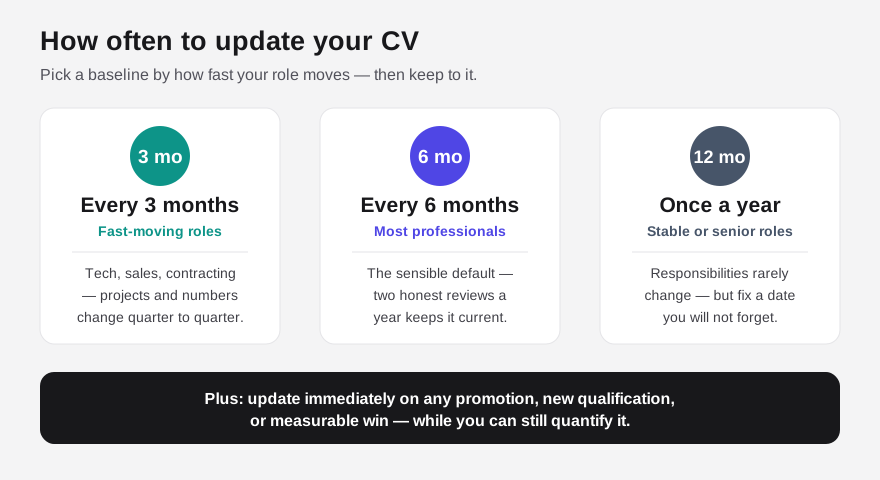
- Every three months if you work in a fast-moving field - tech, sales, contracting, or any role where your projects and numbers change quarter to quarter. Waiting longer means losing the specifics that make a bullet point convincing.
- Every six months for most professionals. Two updates a year keeps your CV honest and current without turning it into a chore.
- Once a year if your role is stable and your responsibilities rarely change - but still on a fixed date you will not forget, not "whenever I get round to it".
The interval matters less than the habit. A CV reviewed on a schedule stays accurate; a CV reviewed only in a panic ends up vague, because vague is what you remember when the detail has faded.
The events that should always trigger a CV update
Calendar intervals are the baseline. The more important updates are event-driven - moments when something changes that your CV should capture immediately, while you can still quantify it.
- A promotion or new job title - update the same week, so the title and the date are exact.
- A new responsibility even without a title change - managing a budget, leading a project, taking on a direct report.
- A measurable result - a target hit, a cost cut, a process you improved, revenue you influenced. Write down the number now; you will not remember it precisely in a year.
- A completed qualification, certification, or course - including the ones your employer paid for and you promptly forgot to record.
- A new tool or skill you now use daily - particularly software and platforms that double as ATS keywords.
- A notable win - an award, a piece of positive client or stakeholder feedback, a presentation you delivered.
The reason to update on the event rather than the calendar is precision. "Reduced onboarding time" is a duty. "Cut new-starter onboarding from three weeks to nine days" is evidence - and you only have that second version if you write it down while it is fresh. Our guide to CV bullet points that pass ATS covers how to turn each of these moments into a bullet that works for both the software and the recruiter.
What "updating your CV" actually means
Adding your latest job is the obvious part, and the least important. A genuine update is a short review of the whole document, because a CV does not just gain content over time - it goes out of date at the top and the bottom.
A proper refresh covers four things:
- Add the new - recent roles, results, qualifications, and skills since the last review.
- Sharpen the recent - rewrite the top third so your current role leads with achievements, not a job description.
- Refresh the keywords - the language of your field shifts, and so do the terms an Applicant Tracking System searches for. ATS software is standard at large employers, and a CV built around last year's vocabulary ranks lower in a recruiter's database search.
- Cut the stale - remove what no longer earns its place (more on this below).
This is different from tailoring. Updating keeps your master CV accurate over time; tailoring adapts that master to a specific advert at the point of applying. You still tailor per application - our guide on whether to tailor your CV for every job covers that - but tailoring is far faster and far better when it starts from a CV that is already current.
Why a stale CV costs you real opportunities
The cost of an out-of-date CV is not visible, which is exactly why it is easy to ignore. You do not get a rejection email that says "your CV was three years out of date". You simply respond slower, remember less, and present a weaker version of yourself than the facts justify. The least visible copy of all is the one sitting on a job board, turning up unattended in recruiter searches months after you uploaded it - which is why how many versions of your CV you keep matters as much as how current the main one is.
When popular vacancies attract far more applications than a recruiter can read in full, speed and specificity both matter. The candidate whose CV is ready applies the day a role appears, with accurate numbers and current keywords. The candidate whose CV is two years stale either applies late with something vague, or talks themselves out of applying because "the CV needs work first" - and the deadline passes.
There is also a quieter cost. Keeping a CV current forces you, twice a year, to look honestly at what you have actually achieved. People who do this tend to notice when a role has stopped developing them long before they would have otherwise - which is useful information whether or not you are planning to move.
What to strip out as your CV ages
Updating is as much about removal as addition. A CV that only ever grows becomes a liability: too long, top-heavy with old detail, and slower for a recruiter to scan. The UK standard is two sides of A4, so every addition eventually needs to earn its space against something older. Our guide to how long a CV should be covers the two-page discipline in full.
As your CV matures, periodically cut:
- Old roles in detail - jobs from more than 10–15 years ago belong in a brief "earlier career" line, not a full entry with bullet points.
- Early-career filler - Saturday jobs and unrelated temporary work, once you have relevant experience to replace them.
- Obvious or dated skills - "proficient in Microsoft Word", "email", or a software version no employer still runs.
- A generic personal profile you wrote years ago and never revisited - one of the CV red flags recruiters notice most.
- Outdated contact details - an old email address or a defunct LinkedIn URL that quietly breaks your first impression.
The test for anything on the page is simple: does it help you get the kind of job you want next? If it does not, its space is better spent on something recent that does.
FAQ
How often should you update your CV if you are not job hunting?
Every six months is a sensible baseline even when you are settled. The point is not to be constantly applying - it is to capture achievements and numbers while they are fresh, so your CV is accurate and ready if an opportunity appears unexpectedly. A settled professional who never updates is the one most caught out by a sudden approach.
Should I update my CV every time I apply for a job?
Those are two different tasks. Keep your master CV updated on a schedule so it stays accurate. Then tailor a copy of it to each specific advert when you apply. Tailoring from a current, well-maintained master takes minutes; tailoring from a two-year-old CV means fixing it and adapting it at the same time, under deadline pressure.
Does updating my CV help it pass ATS screening?
Indirectly, yes. Refreshing your CV is the natural moment to check that its keywords match how roles in your field are currently described, since the terms an ATS searches for shift over time. A CV built around current vocabulary ranks better in recruiter database searches than one frozen a few years ago.
What should I remove when I update my CV?
Old roles in full detail, early-career filler unrelated to your target job, dated or obvious skills, and any generic profile you have not revisited. The UK two-page standard means new content should displace old content rather than simply pile on top of it. Keep what helps you get your next role; cut the rest.
How long does it take to update a CV properly?
A scheduled update on a CV you maintain takes 20 to 30 minutes - add recent wins, sharpen the top section, check the keywords, trim anything stale. It only becomes a multi-hour ordeal when you have left it so long that you are effectively rebuilding it from memory, which is exactly the situation regular updates prevent.
Keep your CV ready, then check it works
A current CV is worth little if it still fails the automated screen it will face the moment you apply. Updating keeps the content accurate; it does not tell you whether an Applicant Tracking System can actually read it or whether it carries the keywords for the roles you want next.
Scan your CV free - Shadow CV checks it the way an ATS does and shows you exactly what is costing you points, from parsing problems to missing keywords. The £5 rewrite fixes the formatting and integrates the keywords naturally, so the CV you kept up to date is also one that passes the filter - once, with no monthly subscription.