Key Takeaways
- NHS supporting information is scored against the person specification, criterion by criterion - it decides shortlisting, not your CV.
- Structure it around the criteria: use each essential criterion as a heading and evidence it with a specific example.
- Respect the limits: 1,500 words on many Trac trusts, 5,000 characters in the NHS Jobs criteria boxes.
The NHS supporting information section is the part of the application form that decides whether you are shortlisted, and it is the part most applicants treat as an afterthought. Search results for it are dominated by template collections - paste-in paragraphs for a band 3 admin post or a band 6 nurse - and almost none of them mention the one fact that changes how you write it: the section is scored, criterion by criterion, against the person specification. This guide works from the NHS's own applicant guidance, not from templates.
What the NHS supporting information section actually is
Every application made through NHS Jobs or Trac - the two platforms that carry the vast majority of NHS vacancies - is an application form, not a CV submission. Somewhere in that form is a large free-text box. NHS Jobs calls it supporting information. Adverts variously call it a supporting statement or a personal statement, and most people searching for help call it a band 5 or band 6 nurse personal statement. It is the same box everywhere: the place you evidence, in your own words, that you meet the requirements of the post.
The official NHS Jobs applicant guidance describes the section as "your opportunity to sell yourself", and lists what belongs in it: your duties and responsibilities, the skills, knowledge and experience relevant to the post, any employment gaps, voluntary work, and research, publication or presentation experience.
Note what is not on that list: your CV. In NHS recruitment the CV is supplementary - on many applications it exists mainly to pre-populate the form, and in NHS Scotland the uploaded file is not even shown to the shortlisting panel. The form is the document that gets scored, and the CV's job is to back it up with parseable evidence. If you have been writing a beautiful CV and a rushed supporting statement, you have had the priorities exactly backwards. The section is also a different animal from the three or four summary lines at the top of a CV - the two documents share the name "personal statement" and almost nothing else.
How NHS supporting information is scored
Shortlisting for NHS posts is not an impression formed by skim-reading. Mersey Care NHS Foundation Trust's applicant guidance states it plainly: "Applications are assessed by a scoring system based on the requirements listed in the person specification for the role." Each essential and desirable criterion is a line on a scoresheet. Your application either evidences it or it does not.
The NHS Jobs guidance says the same thing from the other side of the desk: employers judge "how well your application matches the person specification", and "the applicants who closely match the person specification will be the ones that are shortlisted for interview". The person specification is not background reading attached to the advert. It is the marking scheme - the same way a job description works as a marking scheme in the private sector, except the NHS publishes its version and then scores against it literally.
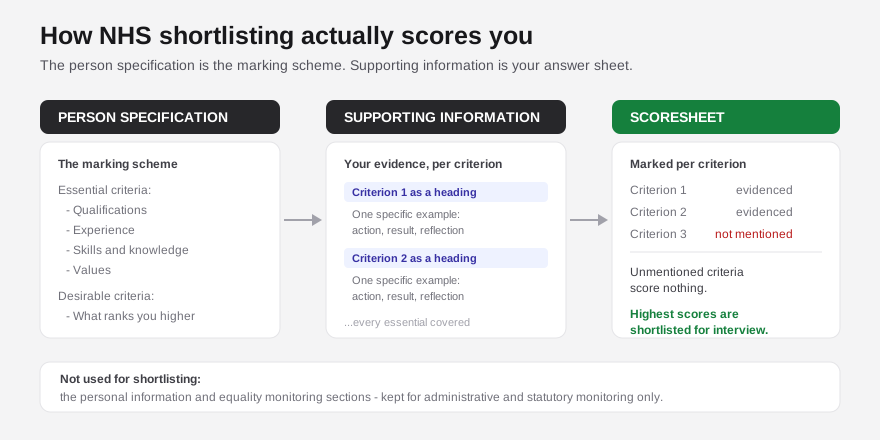
Two useful facts follow from the scoring system. First, the personal information and equality monitoring sections of the form are not used for shortlisting - the NHS Jobs guidance is explicit that they are kept for administrative and statutory monitoring purposes only. Second, a criterion you never mention scores nothing. There are no marks for evidence the scorer has to infer.
The word limits nobody tells you about
The section has hard limits, and they vary by platform.
- Trac: trusts commonly cap supporting information at 1,500 words. Mersey Care's guidance names the figure directly: "You have a 1500 word maximum on this section, so use it wisely!"
- NHS Jobs: the NHS Business Services Authority's help centre confirms the essential and desirable criteria text boxes accept up to 5,000 characters - roughly 700 to 800 words - with a live character countdown as you type.
The limits change how you budget the space. A person specification with eight essential criteria and a 1,500-word ceiling gives you fewer than 200 words per criterion. That is the real reason template paragraphs fail: a pasted 400-word introduction about your passion for healthcare has already spent two criteria's worth of space scoring nothing.

How to structure supporting information that scores
Since the section is marked criterion by criterion, the structure that scores best is the one that mirrors the scoresheet. This is not a trick - it is what trusts themselves recommend. Mersey Care's guidance offers the method as its top tip: "Write the heading from the person specification and then complete underneath how you meet it."
- Open the person specification - usually the final pages of the job description attachment - and list the essential criteria, then the desirable ones.
- Use each criterion as a heading, in the order the person specification lists them, so the scorer never has to hunt for your evidence.
- Under each heading, give one specific example of you demonstrating that criterion. Name what you did, how, and what happened.
- Cover every essential criterion, even briefly. An unaddressed essential criterion is an unanswered exam question.
- Add desirable criteria you genuinely meet, after the essentials. They separate candidates when several score full marks on the must-haves.
For the examples themselves, NHS trusts widely recommend a structure the private sector knows as STAR - with one addition. Mersey Care's version is STARR: Situation, Task, Action, Result, and Reflection - what you learned, and what you would do differently. Reflective practice runs through NHS professional standards, and an example that ends with what you learned reads as written by someone who works that way.
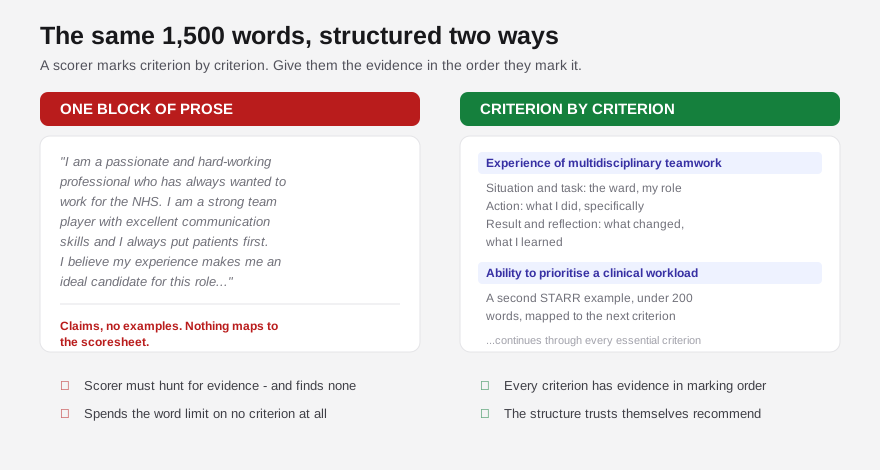
Here is the difference in miniature, for a common criterion like "experience of working as part of a multidisciplinary team":
- Weak: "I am a strong team player who works well with colleagues at all levels and always puts patients first."
- Strong: "On a 24-bed surgical ward I worked daily with physiotherapists, occupational therapists and discharge coordinators to plan safe discharges. When a patient's home assessment was delayed, I arranged an earlier joint review with the OT, which brought the discharge forward by two days. It taught me to raise coordination problems at the morning huddle rather than waiting for the formal meeting."
The weak version asserts the criterion. The strong version evidences it, in under a hundred words, with a result and a reflection. One scores; the other hopes.
Working the NHS values in without reciting them
The NHS Constitution for England sets out six values: working together for patients, respect and dignity, commitment to quality of care, compassion, improving lives, and everyone counts. Person specifications regularly include a values criterion, and trusts add their own local versions.
The mistake is treating values as vocabulary - closing the statement with a sentence that names all six. A values criterion is scored like any other: on evidence. The discharge example above already demonstrates working together for patients without using the phrase. Pick examples where the value is visible in what you did, and let the scorer make the connection - or name one value, once, attached to a concrete action.
The mistakes that stop NHS applications being shortlisted
- Reusing the last application. The NHS Jobs guidance could not be clearer: "Never submit the same application form twice. Always adapt it to show how you meet the person specification of the particular post." Two band 5 adverts at neighbouring trusts can carry visibly different criteria lists.
- Pasting in your CV profile. Three lines of summary written to open a CV evidence nothing against a criteria list. The section needs examples, not a professional summary.
- Leaving employment gaps unexplained. The NHS Jobs guidance specifically asks applicants to identify gaps in the supporting information section, and Trac forms require the time to be accounted for. A one-line factual explanation is all it takes - the same rules that apply to gaps on a CV apply here.
- Ignoring the desirable criteria. When every shortlisted candidate meets the essentials, desirables decide the ranking. If you meet one, say so and evidence it.
- Writing to the limit on the wrong things. A long opening about your motivation and a long closing about the trust's reputation spend hundreds of words on no criterion at all. Spend the words where the marks are.
FAQ
Is NHS supporting information the same as a personal statement?
On an NHS application form, yes - supporting information, supporting statement and personal statement all refer to the same free-text section, scored against the person specification. It is not the same as the three or four line personal statement at the top of a CV, which is a summary rather than an evidence document.
How long should NHS supporting information be?
As long as the criteria require, within the platform's limit - commonly 1,500 words on Trac trusts, and 5,000 characters in the NHS Jobs service's criteria boxes. Length is not the goal: full coverage of the essential criteria is. A statement that evidences all eight essentials in 1,100 words beats one that spends 1,500 on four of them.
Do you have to use the STAR method for NHS applications?
No trust mandates it, but structuring each example as Situation, Task, Action, Result - and ideally the NHS-favoured fifth step, Reflection - is the easiest way to make sure every example actually contains evidence and an outcome rather than a claim. It also keeps examples short, which matters inside a word limit.
Does your CV still matter for NHS jobs?
Yes, but as a supporting document. It often pre-populates the form, and its employment history must match what the form says. Format it to parse cleanly and mirror the person specification's wording - but the supporting information section is what gets scored.
Do you need to mention the NHS values by name?
Not all six, and not as a list. Values criteria are scored on evidence like everything else, so choose examples where a value is demonstrated by your actions. Naming one value in direct connection to something you did is stronger than reciting the set.
Check the document that feeds the form
The supporting information section is written from your raw material - and for most applicants that raw material is the CV, whether it pre-populates the form or just sits open in the next window. If the CV is missing the person specification's vocabulary, the statement usually is too.
Scan your CV free - Shadow CV reads it the way recruitment software does and shows you which keywords from your target role are missing, before you write a criterion-by-criterion statement around the wrong evidence. The £5 rewrite rebuilds it against the wording the scoresheet uses - once, with no monthly subscription.