Key Takeaways
- A finance CV ATS check in the UK scores you on exact-match keywords like ACA, ACCA, IFRS, and named systems such as SAP - not paraphrases.
- With 2.6 unemployed people per vacancy in late 2025, single-column formatting and quantified bullet points matter more than ever.
- Recruiters are also now screening out generic, AI-sounding CVs, so specificity matters twice over.
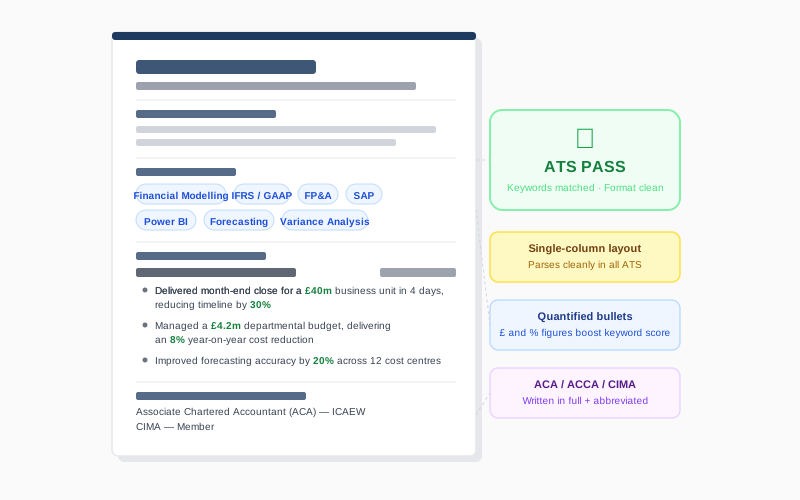
A finance recruiter at a UK bank can receive several hundred CVs for a single qualified-accountant role. Almost none are read in full by a human first. Your finance CV is parsed, scored, and ranked by an Applicant Tracking System (ATS) before a recruiter ever opens it - and in 2026's market, the bar that filter is set at has only risen.
The frustrating part is who gets filtered out. It is rarely the least qualified applicants. It is the ones whose CV the software could not read cleanly, or could not match to the role's keywords. A first-class ACA who submits a beautifully designed two-column CV can score lower than an average candidate who submitted plain text. This guide covers how finance-sector ATS works in the UK, the keywords and formatting that pass it, and the mistakes that quietly bin strong finance candidates.
For the wider picture of how these systems parse any CV, start with what ATS software is and how it works.
Why Finance CVs Face Tougher ATS Screening in 2026
UK financial services is hiring again - but carefully. In a December 2025 KPMG survey of 150 sector leaders, 55% expected to hire more staff in 2026. Robert Half's 2026 data found 58% of UK finance and accounting employers planning to increase permanent headcount by summer, up from 50% the previous period.
That does not mean it is easy to get in. The defining feature of the 2026 finance market is selectivity: deeper interview processes, higher benchmarks, and more weight on demonstrable commercial impact. The wider labour market backs this up - the Office for National Statistics recorded 2.6 unemployed people per vacancy in late 2025, up from 1.9 a year earlier. More candidates are competing for each role, which means the ATS filter is doing more work than ever.
There is also a new wrinkle specific to this cycle. Finance recruiters are now actively screening for generic, AI-generated CVs - Robert Half explicitly notes recruiters working to filter AI-written applications so that skills are validated before a candidate is met. A CV that reads as mass-produced is a liability. Passing the ATS is necessary, but it is not sufficient: the document also has to convince a human that you are real and specific.
Which ATS Platforms UK Finance Employers Use
Large UK financial employers run enterprise-grade ATS platforms. The two you are most likely to meet are SAP SuccessFactors and Workday. HSBC, for example, runs SAP SuccessFactors as the backbone of its HR systems across its global workforce. These are the same class of system used across banking, insurance, and large professional-services firms.
What matters for your CV is how they behave, and it is the same behaviour across all of them:
- They convert your document to plain text first. Anything that does not survive that conversion - tables, columns, text boxes, graphics - is scrambled or dropped.
- They score your CV against the specific job description's keywords, then rank candidates.
- Applications below the employer's threshold are filtered out before a recruiter sees them.
Smaller finance employers and fintechs may not run a dedicated enterprise ATS, but they almost always use the ATS features built into job boards like Reed, Totaljobs, or LinkedIn Jobs. Either way, your application is machine-screened before it is human-screened. For more on how that parsing actually works, see what ATS software is and why it rejects CVs.
Finance CV Keywords That Pass the ATS Filter
Finance is a keyword-dense field, which is good news: the right terms are concrete and well-defined. The ATS is looking for an exact or close match between the job description and your CV. It does not infer. If the advert says "financial modelling" and your CV says "built models," the system may not register the match.
Pull the keywords directly from the job advert and mirror the exact phrasing. For most UK finance roles, the ATS will be scanning for a mix of:
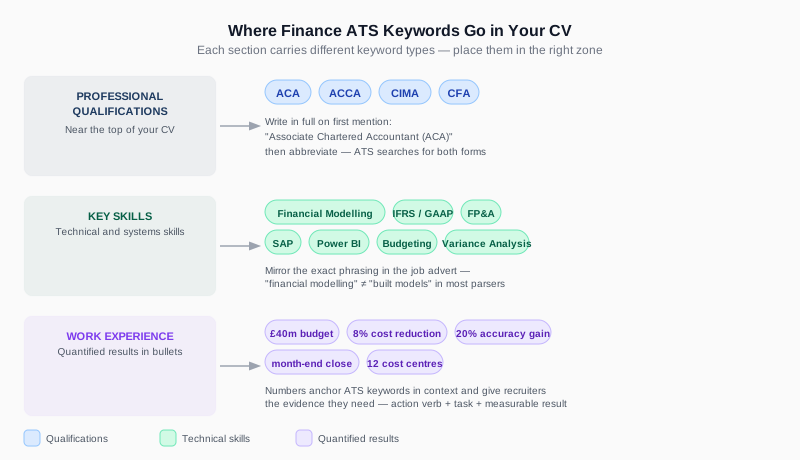
- Technical skills: financial modelling, variance analysis, FP&A, management accounts, reconciliations, forecasting, budgeting, financial reporting
- Standards and compliance: IFRS, UK GAAP, SOX, statutory accounts
- Systems: SAP, Oracle, Excel (advanced), Power BI, Sage, NetSuite
- Qualifications: ACA, ACCA, CIMA, CFA - written in full on first use, then abbreviated
Write professional qualifications both ways. Use "Associate Chartered Accountant (ACA)" on first mention, then "ACA" afterwards. Different ATS configurations search for different forms, and including both maximises your match rate. The same applies to part-qualified status - state it plainly ("ACCA part-qualified, 12 of 14 exams passed") rather than leaving it ambiguous.
For a complete method for finding and placing the right terms, read how to find and use ATS keywords in your CV.

How to Format a Finance CV for ATS
Finance rewards precision, and your CV format is the first test of it. A cluttered, mis-parsed CV signals the opposite of the attention to detail the sector demands.
The rules are mechanical:
- Single-column layout only. Two-column "City CV" templates are read left-to-right across both columns and come out as garbled merged text.
- Standard section headings: Professional Summary, Key Skills, Work Experience, Education, Professional Qualifications. Do not use creative headings the parser will not recognise.
- Reverse-chronological work history - most recent role first.
- Standard fonts (Arial, Calibri, Times New Roman) at 10–12pt.
- No tables, text boxes, columns, logos, or photos. A photo has no place on a UK finance CV and wastes space the ATS needs as searchable text.
- Consistent date format throughout (for example "Mar 2023 – Present"). Parsers use dates to calculate tenure; mixed formats produce misread employment gaps.
- Save as .docx unless the advert specifies otherwise. A clean, text-based PDF also parses well in modern systems - but never a design-tool export where the text is effectively an image.
Put your professional qualifications and any registrations where they are easy to find: a dedicated Professional Qualifications section near the top for qualified roles, or within Education for early-career candidates.
If you are working from a two-column "City CV" template, rebuilding is quicker than unpicking it. Our free CV builder only outputs single-column, parse-safe layouts with standard headings and a .docx export, so every rule above is enforced by default.
Finance CV Bullet Points: Show the Numbers
Finance is the ideal sector for quantified achievements, because the work produces numbers. Every bullet should follow the same shape: action verb, specific task, measurable outcome. Vague duty statements score poorly with both the ATS and the human who reads it next.
Accountant:
- Weak: "Responsible for month-end and reporting"
- Strong: "Delivered month-end close for a £40m-turnover business unit within 4 working days, reducing the previous timeline by 30%"
Financial analyst:
- Weak: "Built financial models and did analysis"
- Strong: "Developed a three-statement financial model that improved forecasting accuracy by 20% across 12 cost centres"
Finance manager:
- Weak: "Managed budgets and a small team"
- Strong: "Managed a £4.2m departmental budget and a team of 5, delivering an 8% year-on-year cost reduction without headcount loss"
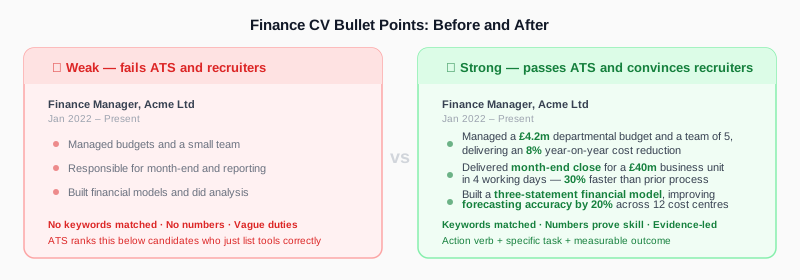
Each strong version does three things at once: it uses exact-match keywords the ATS wants ("financial model", "month-end close", "budget"), it proves the skill with a number, and it gives a human recruiter concrete evidence. For the full formula, see how to write CV bullet points that pass ATS.
Common Finance CV Mistakes That Trigger ATS Rejection
Five mistakes account for most avoidable finance-CV rejections:
- The generic, untailored CV. Sending the same CV to every role means missing the specific keywords each job description demands. Tailoring is not optional in a 2.6-per-vacancy market.
- The design-led "City CV". Multi-column layouts, sidebars, and skill-rating bars look sharp to a human and parse to nonsense in an ATS.
- Missing or buried qualifications. If ACA, ACCA, or CIMA status is required and the ATS cannot find it, you are filtered out regardless of experience.
- Inconsistent date formats. These confuse the tenure calculation and can flag phantom employment gaps.
- Keyword stuffing. Cramming a skills section with every finance term you can think of reads as manipulation to a human and can be flagged by smarter parsers. Use the keywords the role actually calls for, in context.
FAQ
Do UK banks and finance firms really use ATS?
Yes. Large UK financial employers run enterprise ATS platforms such as SAP SuccessFactors and Workday, and applications are machine-screened and scored against the job description before a recruiter reviews them. Smaller finance firms and fintechs typically use the ATS built into job boards. Either way, your CV is read by software first.
Should a finance CV be one page or two?
Two pages is standard for most UK finance roles with a few years of experience. One page suits early-career and graduate candidates. Keep it tight and evidence-led - a longer CV is not a stronger one, and padding dilutes your keyword density.
Should I list ACA, ACCA, or CIMA if I'm only part-qualified?
Yes, and state it precisely. Write "CIMA part-qualified (Strategic level)" or "ACCA, 12 of 14 exams passed" rather than leaving your status vague. The ATS searches for these qualification keywords, and recruiters specifically filter for them.
Is PDF or Word better for a finance CV?
Use .docx unless the advert asks for PDF - it is the most reliably parsed format across enterprise ATS. A clean, text-based PDF also works in modern systems. Never submit a PDF exported from a design tool where the text is rendered as an image, as the ATS will read nothing.
Will an AI-written finance CV get rejected?
It can. UK finance recruiters are increasingly screening for generic AI-generated CVs and validating that skills are genuine. The risk is not that you used a tool - it is that a mass-produced, non-specific CV reads as exactly that. The fix is specificity: real numbers, real systems, real achievements.
Get Your Finance CV Past the ATS
In a finance market defined by selectivity, the candidates who get interviews are the ones whose CV survives the machine and convinces the human. That takes the right keywords, clean single-column formatting, and quantified achievements - applied to the specific role you are targeting.
Scan your finance CV free - Shadow CV checks it against ATS requirements and shows you exactly what's holding it back. The £5 rewrite makes it formatted correctly, keyword-rich, and ready to submit - once, with no monthly subscription.