Key Takeaways
- An apprenticeship CV should be built from the advert's named training course: its "What you'll learn" list copies the official standard, so those words are your keywords.
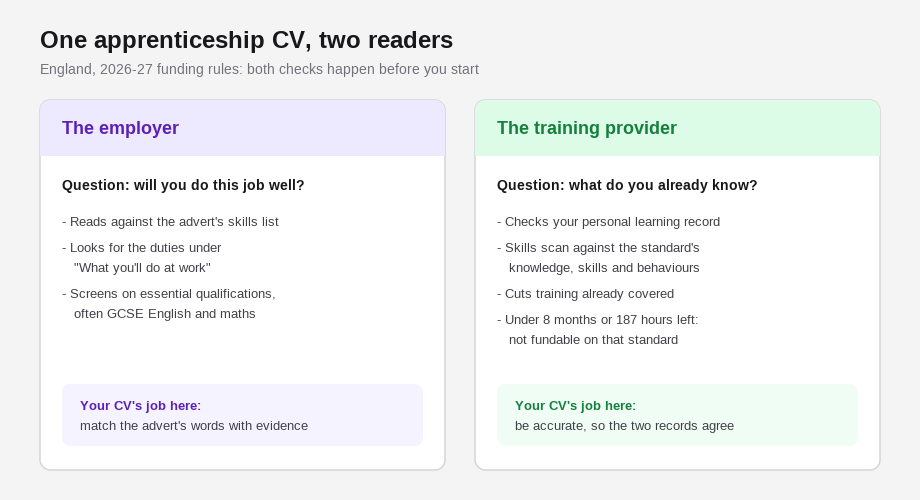
- Two readers check it: the employer for the job, the training provider for eligibility and prior learning.
- Most apprentices are adults, so real work history belongs on it.
Most advice on writing an apprenticeship CV assumes you are 16, have never had a job and need help filling a page. That describes a minority of apprentices. The Department for Education's apprenticeship statistics for 2024/25 record 353,500 starts in England, of which 51.3% were aged 25 and over and only 21.2% were under 19. The provisional figures for August 2025 to April 2026 show the same split.
So the typical apprenticeship CV belongs to a career changer or an existing worker, and it has two jobs: persuade an employer to hire you, and survive a training provider's check of what you already know.
This guide covers England, where vacancies are listed on the government's Find an apprenticeship service. Scotland, Wales and Northern Ireland run separate schemes.
Where the Keywords for an Apprenticeship CV Come From
Every apprenticeship is built on an occupational standard published by Skills England: a list of the knowledge, skills and behaviours (often shortened to KSBs) a competent person in that job needs. The advert tells you which one you are applying for.
We read two live Business administrator (level 3) adverts on Find an apprenticeship on 13 November 2026. Both had the same anatomy:
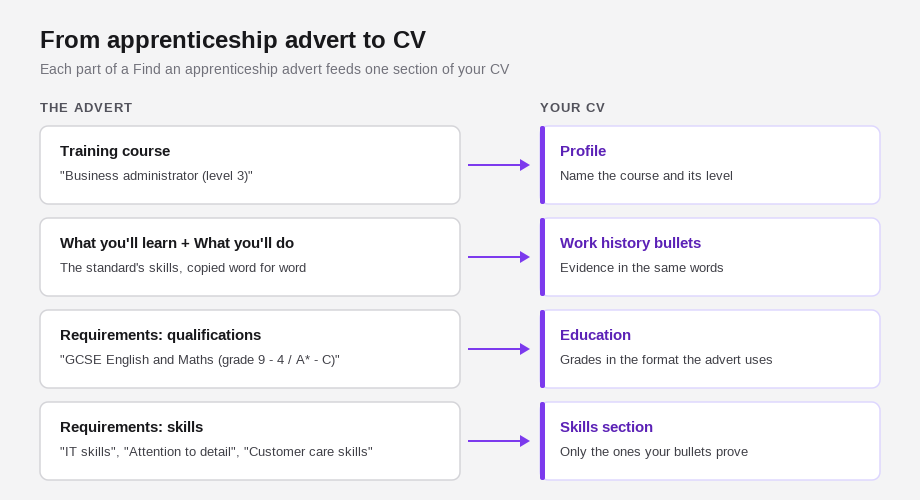
- Training course - "Business administrator (level 3)", named near the top and again in the training section.
- What you'll learn - the standard's skill statements, copied word for word. The first reads: "Skilled in the use of multiple IT packages and systems relevant to the organisation in order to: write letters or emails, create proposals, perform financial processes, record and analyse data."
- What you'll do at work - the employer's own list of duties, such as "Taking orders from customer over the phone" and "Ensuring daily, weekly and monthly deadlines are met".
- Requirements - essential or desirable qualifications (both asked for GCSE English and maths) and a short skills list, such as "Communication skills", "IT skills", "Attention to detail" and "Customer care skills".
- A line inviting your experience - "Share if you have other relevant qualifications and industry experience. The apprenticeship can be adjusted to reflect what you already know."
That is three keyword sources in one advert: the skills list is what this employer chose to ask for, the "What you'll learn" statements are the standard's own vocabulary, and the duties show which parts of the standard this employer cares about most.
If you want the full standard, search for the course name on Skills England's apprenticeship directory. Our guide to reading a job description like a recruiter covers how to split essential from desirable requirements.
How to Write an Apprenticeship CV, Section by Section
Use the standard UK structure: contact details, a short profile, work history, education and skills. If you have little or no work history, put education above it and follow our guide to writing a CV with no experience. If you have worked, work history goes first, because it carries the evidence.
- Profile - three or four lines naming the apprenticeship and the course level, and the experience that already overlaps with the standard. "Applying for the Business administrator (level 3) apprenticeship" is clearer than "seeking a new challenge".
- Work history - for each role, write two to four bullets that match the advert's duties and the standard's statements, with a real number where you have one.
- Education - qualification, grade, institution and year, with GCSE English and maths stated plainly, because both adverts we read listed them as requirements.
- Skills - the advert's own skills list, but only the items you can back up somewhere else on the page.
Here is the difference on one work history entry, for a store supervisor applying to the Business administrator advert above. This is an illustration, not a real candidate.
Weak:
Supervisor, 2021 – present. Responsible for running shifts, dealing with customers and helping the manager with paperwork.
Strong:
Store supervisor, national supermarket chain, Mar 2021 – present
- Build the weekly staff rota for 14 colleagues in the store's scheduling system, and record absences and overtime in time for payroll deadlines.
- Handle customer complaints and refunds at the service desk, keeping accurate records of each case and escalating disputed refunds to the store manager.
- Record and analyse weekly waste and stock-loss data in Excel for the area manager's report.
The strong version uses words from the advert's duties ("customer", "deadlines") and from the standard's statements ("Produces accurate records", "record and analyse data"), and every line describes something a provider could ask you about. If you are moving from a different field, our career change CV guide covers how to translate old job titles and duties into a new sector's terms without overstating them.

The Second Reader: How the Training Provider Uses Your Experience
An apprenticeship is a job plus funded training, so a training provider sits alongside the employer. In both adverts we read, the named contact for the vacancy was the college delivering the training, not the employer.
The provider has to check you against the standard before you start. The Department for Education's apprenticeship funding rules for August 2026 to July 2027 say "the provider must review their prior learning and experience", and that funds must not pay for "knowledge, skills and behaviours the apprentice already has". For everyone aged 19 or over, the provider must:
- Check your personal learning record - a government record of qualifications gained in England since 2012, if you have one.
- Discuss your likely prior learning against the standard with you.
- Run a skills scan against the standard's knowledge, skills and behaviours.
Where prior learning is found, the training plan and the price are cut. If less than 8 months or 187 hours of training would remain, the rules say you "will be ineligible for apprenticeship funding" on that standard. Separately, paragraph 68.2 allows an apprenticeship at the same or a lower level than a qualification you already hold only if it gives you "significant new skills" and the content is "materially different".
What this means for your CV:
- Do not play your experience down. The provider will see your qualifications on your learning record and your experience in the skills scan, so in our view an understated CV only creates a mismatch you have to explain later. A shorter course is a normal outcome. As GOV.UK puts it, you "could spend less time training or qualify earlier if you have relevant experience".
- Do aim at the right level. If your experience already covers most of a standard, the honest fix is a higher-level standard in the same area, not a thinner CV.
- List every relevant qualification. Include ones you think are too low to matter, so nothing surprises the provider later.
This applies mainly to adults. The rules expect most 16 to 18-year-olds to have little or no prior learning, so for school leavers the employer's read is the one that decides.
English and Maths on an Apprenticeship CV
Since 11 February 2025, apprentices aged 19 and over at the start no longer have to achieve level 2 English and maths to complete. The employer decides whether to require them. The rule still applies to 16 to 18-year-olds on a level 3 or higher apprenticeship, who must "hold or achieve an approved level 2 in both subjects". On a level 2 apprenticeship, a 16 to 18-year-old without level 1 English and maths must achieve at least level 1.
That is a change to completion rules, not to recruitment. Both adverts we read still listed GCSE English and maths at grade 4 or C, one as essential and one as desirable. So state your grades exactly, in the format the advert uses:
- Write both grade systems if needed - "GCSE English Language 5 (strong pass), Maths 4 (standard pass, equivalent to C)" when the advert asks for "grade 9 - 4 / A* - C".
- Name functional skills properly - "Functional Skills English Level 2" is a level 2 qualification and should be written in full, not as "English (passed)".
- Leave nothing implied - if you do not hold a pass, list what you do hold rather than leaving the subject off. An adult applicant may not need it at all.
Our education section guide explains how to write GCSE grades in both number and letter form.
FAQ
Do you need a CV to apply for an apprenticeship?
Not always. GOV.UK's three steps are search, sign in, then "complete and submit your application", and one of the two adverts we read sent applicants to the company's own website instead. We would write the CV anyway: it is what you copy from when filling in an application form, and an employer's own site may ask you to upload one.
Can you do an apprenticeship at 25, 30 or older?
Yes. GOV.UK lists the conditions as being 16 or over, living in England and not in full-time education, and gives no upper age limit. Over half of starts in 2024/25 were aged 25 and over. The difference for adults is the prior learning check, which can shorten the course.
Can you do an apprenticeship if you already have a degree?
Sometimes. The funding rules allow an apprenticeship at the same or a lower level than a qualification you hold only if it gives you significant new skills and the content is materially different. In our reading of that rule, a graduate moving into an unrelated trade should be fine, while a level 3 course in the subject you studied at university is unlikely to be funded.
How long should an apprenticeship CV be?
One page if you are leaving school with little work history, and up to two sides of A4 if you have worked.
What if you do not get an interview?
Ask. GOV.UK says you can request feedback if you are not selected for an interview or the apprenticeship. Then recheck your CV against the advert's skills list and the course standard.
Shadow CV's free scan checks your CV against the role you are applying for and shows which of the advert's skills and keywords it is missing. If the gap is bigger than an evening's edit, the £5 rewrite fills it from your real experience, without inventing anything a provider's skills scan would later contradict. Scan your apprenticeship CV free.